Awakening Together

A universal assembly for true discernment

NON-DUAL PURPOSE & PRACTICE

  • Email
  • Facebook
  • Instagram
  • TikTok
  • Twitter
  • YouTube
  • About Us
    • Start Here
    • Purpose and Values
      • One True Self
        • More About the True Self
      • Unique Inner Guidance
      • Spiritual Intuition
    • Paths of Awakening
    • Spiritual Practices
    • Ministers
    • Frequently Asked Questions
    • Governance
      • Board of Directors
      • Member Board Trustees
      • Trustee Minutes
      • Constitution, Bylaws, Policies & Procedures
      • Member Meeting Audios
      • AT Financial Reports
    • Volunteer Opportunities
  • News
    • Visiting Minister’s Program
    • More News
  • Events
  • Sanctuary
    • About Our Online Sanctuary
      • What is the Sanctuary?
      • Sunday Morning Gatherings
      • Sanctuary Etiquette
      • How to Become a Presenter
    • Enter the Sanctuary
    • Online Sanctuary Livestream
  • Courses
    • Minister Preparation Program (MPP)
    • ZOOM: Intro to Kabbalah
    • Zoom: Intro to MPP
    • Upcoming MPP Courses
    • 500_Days_ w/ NTI
      • About 500 Days with NTI
      • What is NTI?
      • First 100 Days
      • Days 101 – 200
      • Days 201 – 300
      • Days 301 – 400
      • Days 401 – 500
    • Gentle _Healing
      • Audios & Homework
        • For Year 1
        • For Year 2
        • For Year 3
      • Gentle Healing Tips
        • Regina’s Tips – Year 1
        • Regina’s Tips – Year 2
        • Gentle Healing – Year 3
      • Gentle Healing Playlist
      • New Group Notification
  • Audios
    • Podcasts
    • Sanctuary Teachers & Recordings
    • Weekly Gatherings
    • Featured_Guests
      • Satsang in the Sanctuary
        • Helen Hamilton Satsang
        • Jeff Bailey – The Yoga Mind
        • Paul Hedderman – Traveling Lighter
        • Craig Holliday Satsang
        • Nirmala Satsang
        • Gina Lake & Jesus
        • Cate Grieves – ACIM
      • Guest Satsang Interviews
      • Guest Mini-Series
      • Other Featured Guests
  • Regina’s_Audios
    • Who is Regina?
      • Her Biography
      • Her Books
      • Buddha at the Gas Pump Interview
      • Testimonials
    • Most Recent Teachings
      • The Tao Te Ching
      • Clarifying the Teachings
      • Regina’s Awakening Games
      • Seven Steps to Awakening & Out of the Stillness
    • Core Teachings
      • NTI Study – With Regina
      • Teachings of Inner Ramana
      • Guiding Light Book Study
    • Early Teachings
      • Snippets from Early Teachings
      • Original Oldies & Classics
    • More RDA Audios
      • RDA Guided Meditations
      • Enlightened Leadership: Tao
      • Talks by Regina
  • Retreats
    • All Upcoming Retreats
    • Awakening at Home, Online: May 19-23
    • Four Principles of God, In-Person: Aug 11-15
    • Retreat Final Payment
    • Scholarship Opportunities
    • Reflections from Our Retreats
  • Retreat_House
    • About the Retreat House
      • Retreat House Caretakers
      • Retreat House Amenities
      • About the Local Area
      • Airports & Driving Directions
      • Frequently Asked Questions
      • Testimonials About the Retreat House
      • Pictures (worth 1000 words)
    • Shuttle Information
    • Reservation Information
      • Lodging Options & Rates
      • Apply for Lodging
    • Offer a Retreat at the RH
    • Donate to the Retreat House
  • Resources
    • Forum
    • Books
      • Tao Te Ching: An Interpretive Translation to Live By
      • The Holy Spirit’s Interpretation of the New Testament (NTI)
      • The Teachings of Inner Ramana
      • Thoughts of Awakening
      • Out of the Stillness
    • Free E-books
    • Practices
      • Meditation Audios
      • Root Cause Inquiry
    • Podcasts
    • YouTube Channel
    • Articles
      • Jeshua Through Brent Haskell
    • Music
  • Join Us
  • Subscribe
  • Donate
    • Start a Monthly Donation
    • Make a One-time Donation
    • Donate by Mail
    • Support the Retreat House
    • Bequests-Planned Giving
  • Outreach
    • 1-on-1 Spiritual Mentoring
    • Mentoring Sangha
    • Benevolence Programs
    • Prayer By Request
You are here: Home / Archives for Gentle Healing Homepage / GentleHealingTips-Year1

Tips from Regina ~ For Week Five on Lessons 29-35

February 14, 2017

Regina’s Tip for Lesson 29

This week’s reading from NTI Colossians says:

“You are the flow that is the first and the last, the beginning and the end, the creator of all things within time. You are the heavens and the earth, the bees and the sunshine. You are the process that made all things and is all things, so they live through the process that created them. You are the flow of Life and separate from nothing that is Life, for that which flows through them is the process that you are. You are beyond concepts and difference and form, and within the Life force that is all things.”

When NTI says, “You are the process that made all things,” and “You are the flow of Life,” it means you are That which is God.

Today’s lesson says:

“God is in everything I see. … You will probably find this idea very difficult to grasp at this point. You may find it silly, irreverent, senseless, funny and even objectionable. Certainly God is not in a table, for example, as you see it.”

For some people, it may seem objectionable to say, for example, “God is in that waste basket.” It may be even more objectionable to say, “I am God,” and it may seem ridiculous to say, “I am in that waste basket.” I don’t ask you to say, “I am in that waste basket.” I’d like you to follow the Workbook lesson instructions as they are written. However, I’d like you to contemplate this as you do the workbook lessons:

You’ve seen the video about my experience as an apple, and you’ve seen the video about my experience with the towel rack and floor. The life-awareness and divine love that I experienced in those objects is God. The life-awareness and divine love that I experienced in those objects is in everything that you see. Also, the life-awareness and divine love that I experienced in those objects is what you are.

You are no different than the waste basket, because it is life-awareness divine love, and so are you.

You are no different than the door, because it is life-awareness divine love, and so are you.

You are no different than another body, because it is life-awareness divine love, and so are you.

You are no different than a lamp, because it is life-awareness divine love, and so are you.

You are not different than a finger, because it is life-awareness divine love, and so are you.

You are no different than a magazine, because it is life-awareness divine love, and so are you.

You are no different than a coat hanger, because it is life-awareness divine love, and so are you.

Regina’s Tip for Lesson 30

Pause for a moment and notice yourself.
Notice that you are aware.
Notice that you are present now.

Now, look at something near you.
Notice that it is in your awareness.
Notice that it is present now.

Look at something a little further away from you.
Notice that it is also in your awareness.
Notice it is also present now.

Look at an object that fairly distant from your body, possibly something out the window. Notice that it is in your awareness. It is in your awareness just like the object closer to you is in your awareness. They are equally in your awareness.

Notice that the fairly distant object is also present now.

Think of something that you’ve seen before that you cannot see now. Notice your thought about it is in your awareness, therefore it is in your awareness. You are aware of it now, aren’t you? Both what you see and what you think of is in your awareness. They are equally in your awareness.

Notice the object you are thinking of is present in your awareness now as a thought or as a mental image. In that way, it is present now.

Now, consider these statements:

Your mind is awareness.
Thought appears in mind.
Thought appears in awareness.
Notice these statements are true. Check them in your own experience.

Your mind is life-awareness.
You cannot separate your mind from life.
You cannot point and say, “Life is there and mind is here.” They are one. Notice these statements are true. Check them in your own experience.

Life-awareness is present now.
Thoughts about the past appear in life-awareness, but life-awareness is present now.
Thoughts about the future appear in life-awareness, but life-awareness is present now.
Notice these statements are true. Check them in your own experience.

Regina’s Tip for Lesson 31

Today’s workbook lesson begins by saying:

“Today’s idea is the introduction to your declaration of release.”

This week’s reading assignment may help you understand how “I am not the victim of the world I see” is the introduction to your release. NTI Colossians, Chapter 2 says:

“You are all things, and all things are you. You are the Life that flows in and out of all things. You are the wisdom and knowledge that travels on the current of Life, which moves through everything seen and unseen. In this way, you are absent from nothing, and nothing is disconnected from you. …

“Your mind communicates with all things through the flow of Life that is your reality. It is not partial to the body that you think you are. For within its flow, it is all things without partiality. It reads communication as it travels throughout spirit, and it delivers that which it is given through faith and desire.”

In other words, you are not the victim of the world you see, because the world you see comes from you. That knowledge is the introduction to your release, because when it is understood and accepted, you can change your way of giving attention to thought, and the world you see will change too.

Today’s lesson is related to lessons 18 and 19. Take a few minutes to go back and review the tips from those two lessons. As you review those tips, ask yourself this question:

How is this information the introduction to my release?

See what realizations come as you contemplate that question.

Regina’s Tip for Lesson 32

Today’s lessons says:

“You are not the victim of the world you see because you invented it.  … You will see it or not see it, as you wish. While you want it you will see it; when you no longer want it, it will not be there for you to see.”

NTI Colossians makes the same connection between what you want and what you see. It says:

“For this reason, let your mind be focused on that which you truly want, the motive you have set your mind on.”

Our minds think they want many things, because the thoughts that are received into mind chatter about many things. In one day, you probably cannot count the number of desires that you give attention to, some big and some small. However, most of those desires have one thing in common: they are about the world. Therefore, in wanting those many different things, you continually want the world.

One important step in your release is realizing your spiritual aspiration, and then contemplating that spiritual aspiration deeply until it becomes the only thing that you want.

What is a spiritual aspiration? It’s what you want spiritually.

For example, do you want to be only love? Do you want freedom? Do you want truth realization?

Have you considered what you want spiritually? If not, now is a good time to begin considering that. We will revisit the spiritual aspiration later. Right now, we are only taking beginning steps towards developing a spiritual aspiration.

Please take a few minutes to review the tip for lesson 23, since it is related to today’s lesson and this tip.

Regina’s Tip for Lesson 33

Yesterday, I asked you to review the tip for lesson 23. In that tip, you learned to give attention to thought differently by holding a thought in the mind while saying the daily workbook lesson to yourself. That practice is a simple and powerful practice, since it is different than giving believing-attention to thought.

Holding a thought in the mind and saying the workbook lesson to yourself is another way of looking at thought. Since the world you see comes from the thoughts you give believing-attention to, holding a thought in the mind as you say the workbook lesson is also how you look at the world differently.

Instead of letting the thoughts that come into the mind tell you how to see and experience the world, you choose how you will see and experience the world by choosing which thoughts you will believe and which thoughts you will let go.

This is the practice recommended in NTI Colossians when it says:

“Therefore, do not look at the world letting it tell you what to think. To make this mistake is to participate in illusions, …

“Watch your mind, and you watch what it is that you do. With this knowledge you may gladly choose again.”

 Regina’s Tip for Lesson 34

The tip for lesson 32 pointed out that there is a connection between what you want and the world you see. Today’s workbook lesson helps you to become clear on what you want.

Consider this quote as you practice today’s workbook lesson:

Happiness, true happiness, is an inner quality. It is a state of mind. If your mind is at peace, you are happy. If your mind is at peace, but you have nothing else, you can be happy. If you have everything the world can give – pleasure, possessions, power – but lack peace of mind, you can never be happy.

~ Dada Vaswani

Regina’s Tip for Lesson 35

As today’s Workbook lesson points out, you probably do not see your mind as a part of God’s mind. You probably do not see yourself as “very holy.” However, that is exactly what NTI Ephesians and NTI Colossians teach. That is “what vision will show you.”

Today’s lesson implies that you believe you are a person in a world, because you do not believe you are one with God’s holy mind. NTI Colossians points out how you can begin to reverse this misperception. It suggests that you align yourself with the desire of the Heart. It says:

“Remember this. The desire of the Heart is only this, for this is the only desire it would place on the flow of creation that is you:

“Know thy Self. …

“Place your mind in subordination to your Heart in great joy! For in placing the mind in subordination to the Heart, you join with your Self in the true desire of Self.”

Interestingly, “Heart” is capitalized in this excerpt, which means NTI isn’t referring to the human heart. It refers to the spiritual Heart. The spiritual Heart is the Heart of oneness, which is also called the Self. In oneness, there aren’t many desires like there are among humans. In oneness, there is one true desire. That desire is to know itself as its Self.

Today’s workbook lesson is inspired by this true desire.  It is a call to oneness, inviting it to return from the misperception of separation by remembering itself as a unified whole.

Filed Under: GentleHealingTips-Year1

Tips from Regina ~ For Week Four on Lessons 22-28

February 7, 2017

Regina’s Tip for Lesson 22

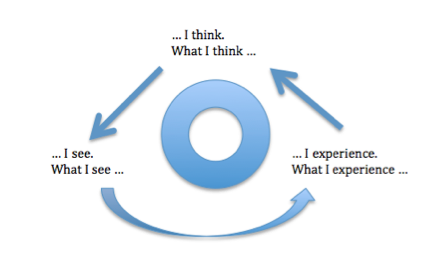
Today’s lesson says, “What I see is a form of vengeance.” As we’ve already learned, what I see comes from thought. Specifically, what I see comes from the thoughts I give believing-attention to. That means if I see attack, I must have given believing-attention to attack in my mind first.

That last statement is true, but it might not seem true since thought, perception and experience are created through a process that works like a loop.

A loop has no discernable beginning. It may appear that you see something, have an experience, and then think about what you’ve seen and experienced.

Nevertheless, since thought is the actual beginning of the loop, what you see and experience can change if you change how you give attention to thought.

Regina’s Tip for Lesson 23

In yesterday’s tip, I shared the loop of experience. That loop is a type of conditioning that runs on autopilot in the brain. It works like this:

We receive thoughts in the mind. Those thoughts are like thoughts we’ve given believing-attention to before. Out of habit, we give believing-attention to those thoughts again, which leads us to see and experience the world in a certain way.

If we want to experience true perception, the perceptual loop of experience needs to be healed, which means it needs to be corrected or put right. Fortunately, today’s workbook lesson gives clear instructions about how we can heal the loop of experience:

  1. “You must learn that it is [attack thoughts] you do not want.”

In other words, you must learn that you want to heal the perceptual loop of experience. It is very good to put effort into increasing your desire to heal this conditioning. You can do that by noticing how much you suffer or by asking questions like, “Is this the world I want to see?”

The mind heals best when it’s given a positive goal. So, as you notice that you don’t want to suffer or don’t want the world you currently see, it’s helpful to restate those realizations as positive goals. For example:

I want freedom, or
I want consistent happiness, or
I want to be the presence of love, or
I want truth realization, etc.

Focus on a positive goal that motivates you to heal the perceptual loop.

  1. “This change requires, first, that the cause be identified and then let go, so that it can be replaced.”The cause is giving believing-attention to attack thoughts when they show up in the mind. Therefore, instead of giving believing-attention, you need to give a different type of attention. That takes us to our next step.
  1. “Hold each attack thought in the mind as you say [the workbook lesson for the day].”One challenge is that conditioning materializes as neural pathways in the brain. Those pathways are like waterslides that enable attack thoughts to slide by quickly without conscious awareness. It’s as if our brain is on automatic pilot, processing attack thoughts with believing-attention whenever they are received.

However, autopilot can be overridden by awareness. When you hold an attack thought in your mind as you say the workbook lesson, you are overriding believing-attention and giving the thought healing-attention instead.

Look at that for a moment and notice how simple the resolution is:

When an attack thought shows up in the mind, instead of believing it, simply look at it as you repeat the current day’s workbook lesson in your mind.

As it says in NTI Luke Chapter 5:

“Old habits must be let go, for old habits will not usher in a new day. With old habits, all things remain the same. But with new habits, all things are possible. …

“You will catch yourself practicing the old habits, for this has been your way until now. Slipping into old habits does not ruin the new ones. So when you find yourself doing this, forgive yourself your attraction to the old by stepping away from the old and stepping into the new. Each time you do this, you help yourself to unlearn the old and to learn the new.”

Regina’s Tip for Lesson 24

NTI Luke 5 begins by saying:

“Things are not as they seem. This is why I ask you to trust Me and follow Me. I know how things are. You are blind to these facts, for you only know what you think you know, and that is nothing but a deep and burdensome slumber.”

Similarly, today’s workbook lesson says:

“What you do is determined by your perception of the situation, and that perception is wrong. It is inevitable, then, that you will not serve your own best interests.”

For a time, it is in your own best interest to trust NTI, these tips and the Workbook more than your own perception. That’s because your perception is determined by faulty thinking, which is giving believing-attention to thoughts that are received without adequately discerning the value or worthlessness of those thoughts.

Today, in addition to the exercises put forth in the Workbook, pause every time you notice an attack thought in your mind and hold that thought in the mind as you say, “I do not perceive my own best interests.”

Regina’s Tip for Lesson 25

Today’s Workbook lesson explains the foundation of misperception. The foundation of misperception is the ego.

Here’s a review from previous tips:

From the tip for Lesson 1 – “Mistaken perception is perceiving and interpreting the world through a self-centered mental filter, known as the ego. The ego is basically a mental program that has been built throughout your lifetime. It tells you who you are, what everything you experience is, and it gives self-referencing meaning to everything you perceive. Meaning that is created through self-referencing is mistaken perception, because it defines what you see and experience in terms of ‘you’ and what ‘that’ has to do with ‘you.’”

From the tip for Lesson 10 – “You are not who you think you are, and the thoughts that speak to you as if you are this person, are illusions. That is why your thoughts are meaningless. They appear to be self-centered, self-referencing thoughts, but the self they are centered on and referencing is not who you are.”

Since you view the world through self-referencing thoughts, but you are not the self those thoughts refer to, you do not know what anything is for. You think you know what it’s for in relation to who you think you are, but you are wrong about who you think you are. Therefore, you are wrong about everything.

Regina’s Tip for Lesson 26

Yesterday’s Workbook lesson said:

“Everything is for your own best interests. That is what it is for; that is its purpose; that is what it means. It is in recognizing this that your goals become unified. It is in recognizing this that what you see is given meaning.”

Your own best interest is realizing the truth of what you are. The purpose of everything is to help you remember. That is the only real purpose that the world can have.

What are you?

Today’s Workbook lesson points to the answer. It says, “My attack thoughts are attacking my invulnerability.”

In other words, you are Invulnerable. However, you cannot know yourself as Invulnerable as long as you give believing-attention to attack thoughts. That’s because the perceptual loop of experience will lead you to see and experience yourself as vulnerable as long as you give believing-attention to the idea that you, or anyone, can be attacked.

In short, to believe in attack is to believe in vulnerability.

Regina’s Tip for Lesson 27

In the tip for lesson 23, we learned that it’s important to increase our desire to heal the perceptual loop of experience. Today’s lesson helps us increase that desire. In fact, it gives healing “priority among your desires.”

The Workbook lesson says:

“You may feel hesitant about using the idea, on the grounds that you are not sure you really mean it. This does not matter. The purpose of today’s exercises is to bring the time when the idea will be wholly true a little nearer.”

Chapter 18 of A Course in Miracles says:

“Trust not your good intentions. They are not enough. But trust implicitly your willingness, whatever else may enter.”

When you do today’s Workbook lesson, you do it because you are willing to make healing and true perception the priority in your life, even if they aren’t the priority now. As Chapter 18 says, “trust implicitly your willingness.” There is power in your willingness that you do not understand, nor do you need to understand it. Simply do today’s lesson, and let your willingness do the rest.

Regina’s Tip for Lesson 28

Today’s workbook lesson says:

“You may wonder why it is important to say, for example, ‘Above all else I want to see this table differently.’ … When you have seen one thing differently, you will see all things differently. The light you will see in any one of them is the same light you will see in them all.”

In the tip for lesson 15, I shared the story of a light episode when my awareness shifted into an apple, and I became the apple. I have seen everything differently since having that experience. Prior to that experience, I saw humans as very distinct and entirely from different fruit. After that experience, I realized that all living things are the same, because they are the same at their essence, which is life-awareness.

Sometime after that, while walking my dog, I looked down and saw a bug. However, I did not see a bug right away. Before my mind could retrieve the information that identified the form I saw as a bug, my awareness connected with that form as life-awareness. I didn’t have a mystical light episode or anything like that, but my essence connected with the essence in that form as the same essence.

That’s how I see now. I can identify a bug as a bug, an apple as an apple and a human as a human, because that learned information is stored in my brain, but at another level there is an intuitive connection with everything I see as life-awareness.

Immediately after the episode with the apple, I knew all living things are life-awareness, but I made a distinction between living things and inanimate objects. I did not see inanimate objects as life-awareness. About a week after the apple experience I had another mystical experience, which led me to see that everything is alive.

Please watch the following 2-minute video to hear about that mystical experience:


Filed Under: GentleHealingTips-Year1

Tips from Regina ~ For Week Three on Lessons 15-21

January 31, 2017

Regina’s Tip for Lesson 15

Today’s lesson says:

“It is because the thoughts you think you think appear as images that you do not recognize them as nothing.”

NTI Ephesians teaches how the world of experience is made. It calls this process “the law of Love.” Through the law of love, thoughts are received into the mind. We don’t think the thoughts into our minds; we receive them, which is why the Workbook refers to them as “the thoughts you think you think.” Once a thought is received, we judge it as valid or invalid. If we decide a thought is valid, that thought is delivered into manifestation.

It is just as ACIM says:

“The are no idle thoughts. All thinking produces form at some level.”
(T-2.VI.9)

Since we believe a thought and then have an experience in the world that supports that thought, we think our thinking is right. What we don’t realize is the experience was created through believing the thought. It is the law of Love, which is the process of cause (believing a thought) and effect (experience).

Today’s lesson also speaks of light episodes that “symbolize true perception.” I experienced a light episode when my awareness shifted into an apple. During that episode, my awareness resided as the apple. I wasn’t Regina. I was the apple, and as the apple I saw an entirely different world. I experienced a world of light—living aware light, which is also love.

Please watch the following 3-minute video to hear more about this light episode:


Regina’s Tip for Lesson 16

Every thought that comes into the mind represents either the ego and its illusion or the truth. For most people, the vast majority of thoughts—nearly all of them—represent the ego and its illusion.

If you pay close attention to the thoughts that come into the mind, you’ll find attack, defense, guilt, blame, unworthiness, anxiousness, fear, envy, desire, righteousness, victimization, judgment, regrets, manipulation, selfishness and hate, to name a few. If you look at the world, you’ll find these qualities there too. That’s because these thoughts come from the ego’s illusion and these thoughts make the ego’s illusion. It’s a loop of cause and effect. Thought causes manifestation, and one type of manifestation is thought, so thoughts of a certain type create more thoughts of the same type.

Today’s workbook lesson says:

Every thought you have contributes to truth or to illusion; either it extends the truth or it multiplies illusions.

NTI Ephesians says something similar. It says:

Watch the thoughts carefully. Do not choose those which you would not deliver, knowing all that is delivered can be given back to you.

Today’s workbook lesson is a beginning step towards realizing that you do not want to believe every thought your mind receives, because many of those thoughts do not serve you, nor do they serve the world.

Regina’s Tip for Lesson 17

The first time I did this workbook lesson, I didn’t believe, “I see no neutral things.” I thought I saw a neutral wall, a neutral TV and a neutral trashcan, but that was only because my judgments were repressed.

When I did this workbook lesson again years later, it was as if I could remember all of my previous judgments about walls and TVs and trashcans, etc.

For example, I remembered thinking that white walls are boring and different color walls are better. I also remembered being disappointed in a friend’s taste when she built a new house and had all of the walls painted white. I remembered judging people for wanting 65” or 75” TVs, thinking they are too big and unnecessary, but I also remembered judging some smaller TVs as being too small. I remembered thinking trash cans should be inexpensive—after all, they’re just trash cans—and judging one friend for wanting a $65 stainless steel trash can for her kitchen.

Workbook Lesson 17 reminds me of the reading from NTI Luke 12, which said:

“Whenever you look at anything with the body’s eyes, there are thoughts in your mind about that thing. If you look at a chair, for example, you may think it is pretty, worn out, available, desired, not desired, clean, dirty, etc. etc. The thoughts that come into your mind seem automatic, without any awareness or evaluation on your part. You may make judgments about the chair based on your thoughts, and you may choose to sit there or not sit there based on your judgment. But you never look at, evaluate or question the thought you hold about the chair, and that is only a chair.

“The process that you call thinking, of which you are mostly unaware, goes on within your mind regarding everything in your world. You make unevaluated judgments about the work you do, the relationships you have, the pastimes you choose and the person you think of as yourself. These unevaluated judgments define everything and everyone within your world. And they are allowed within your mind without your awareness, your questioning or your evaluation.”

Workbook Lesson 17 and NTI Luke 12 remind us that we see no neutral things, because we see and experience everything through the filter of our thoughts, which are not neutral.

Regina’s Tip for Lesson 18

 NTI Ephesians teaches that thought is received through mind. “Mind” in this context has two meanings:

  1. The receiving mechanism.
  2. Attention.

To receive a thought is actually quite neutral. A thought isn’t given power until it is given believing-attention. Once it is given believing-attention, it is enlivened and becomes manifest in some way. One of the ways a thought becomes manifest is by coloring the way you see. This was taught in NTI Luke 12.

NTI Ephesians also teaches that what is received through mind is delivered through spirit. In this context, spirit is ‘vital substance’ or energy. In other words, once a thought is given believing-attention, it colors the way you see and it continues to have energy throughout mind. That energy becomes manifest and is received by others.

That is why you are not alone in experiencing the effects of your seeing. If you are seeing through a particular thought, you’ve given that thought believing-attention. Once you’ve given it believing-attention, it is shared.

 Regina’s Tip for Lesson 19

 Today’s workbook lessons says:

“Today we are again emphasizing the fact that minds are joined. This is rarely a wholly welcome idea at first, since it seems to carry with it an enormous sense of responsibility, … Despite your initial resistance to this idea, you will yet understand that it must be true if salvation is possible at all. And salvation must be possible because it is the Will of God.”

I once saw a movie about Helen Keller called The Miracle Worker. Helen Keller was both deaf and blind. Since she could not hear and she could not see, she didn’t know how to talk or communicate with others. This created great frustration in her, and sometimes she threw outrageous temper tantrums.

Her parents hired a teacher, who tried to teach Helen sign language by signing against her hand, so she could feel the signs. However, Helen didn’t understand and nothing changed.

One day, Helen threw a temper tantrum at the dinner table. She threw a pitcher of water. Her teacher forcibly took her out to the well to refill the pitcher with water. As she pumped the well, she continually stuck Helen’s hand under the water and signed water against the palm of Helen’s hand. She did this over and over and then, as if by some miracle, Helen understood. For the first time ever, she understood that what her teacher had been teaching was a way of communicating with others. Before, she hadn’t understood the concept of communication. When the concept of communication dawned on her mind, she became eager—really eager—to learn the sign for everything. Understanding the possibility of communication opened the world up to her.

I tell you this story now, because this is how it was for me when I scribed NTI Ephesians. I had been a student ofA Course in Miracles for about 2 years when I received NTI Ephesians. I learned about forgiveness through ACIM. I saw forgiveness as something that made me feel better, but really had no effect beyond that. When NTI Ephesians came, I understood the concept of salvation. I saw that what I give attention to affects me, yes … but beyond that, it affects others. I also saw that what I decide not to give believing-attention to frees me, and it frees others.

That was like my Helen Keller moment at the well!

Suddenly, I wanted to practice not giving believing-attention to every thought that could hurt anyone. I was excited to practice extending salvation to the world by not giving believing-attention to wrong minded thoughts in my mind!

So yes, I saw, “I am not alone in experiencing the effects of my thoughts” as an enormous responsibility, but it was a responsibility I was excited to embrace. Later, when I learned about why Prince Siddhartha left his family’s kingdom to seek enlightenment, I realized he was excited about the possibility of saving the world too. This responsibility can be highly motivating, because we realize we are not practicing spirituality for ‘me’ alone. We practice spirituality for everyone. It is as Ramana Maharshi said:

“Your own Self-Realization is the greatest service you can render the world.”

Note: If you’d like to see Helen Keller’s realization at the well, search YouTube for ‘Water scene from The Miracle Worker,’ or for full context, watch the entire movie, The Miracle Worker.

Regina’s Tip for Lesson 20

 It is genuinely helpful to become more structured in your practice. Some people will find it difficult to remember to practice every half-hour. There are two ways to increase your chances of remembering:

  1. Each time you practice today’s lesson, pause afterwards with a heart-felt intention to remember again in 30 minutes. Look at the current time and make a mental note of the next time you will practice the lesson.
  2. Set an alarm to remind yourself to do the lesson every 30 minutes.

If you don’t use the alarm method for reminding yourself to practice, you may find that you sometimes forget to practice the workbook lesson. It’s possible a couple of hours may pass without remembering to practice. If that happens, don’t condemn yourself. Condemning yourself is never helpful. Simply practice the lesson right then, and then set an intention to practice again in 30 minutes or go ahead and set an alarm.

Regina’s Tip for Lesson 21

Today’s workbook lessons starts by saying, “The idea for today is obviously a continuation and extension of the preceding one.”

It is also a continuation and extension of the lessons before that.

Consider “I am determined to see things differently” in context with the tips from Lessons 18 and 19. When you see things differently, the world is affected differently. That realization can be incredibly motivating.

Remember Ramana Maharshi’s statement:

“Your own Self-Realization is the greatest service you can render the world.”

Contemplate that as you practice the idea for today.

Filed Under: GentleHealingTips-Year1

Tips from Regina ~ For Week Two on Lessons 8-14

January 24, 2017

Regina’s Tip for Lesson 8

My favorite paragraph from today’s lesson is this one:

The one wholly true thought one can hold about the past is that it is not here. To think about it at all is therefore to think about illusions. Very few have realized what is actually entailed in picturing the past or in anticipating the future. The mind is actually blank when it does this, because it is not really thinking about anything.

Pause for a moment, and notice now is now. Then continue to pause, and see if you can find the end of now. Is there an actual boundary where now ends and becomes the past or the future?

If you look at your direct experience, you’ll notice that now never ends. It has no boundary. It is eternal.

Now doesn’t move. Experience comes and goes, just as thoughts come and go, but now is eternally unmoving and present.

Now is real. Yet most people miss now entirely, because they are thinking about the past or imagining the future. An important key to true perception is learning to recognize the reality of now, and to give attention to this present fact.

Do you have a clock or watch with a second hand? If so, try this exercise:

Watch the second hand as it moves around the face of the watch or clock. Notice the second hand moves, but now doesn’t move. Keep your attention focused on the unmoving now as you watch the second hand. Notice now is eternally present and absolutely real.

 Regina’s Tip for Lesson 9

The three most recent workbook lessons are “I see only the past,” “My mind is preoccupied by past thoughts,” and today’s lesson, “I see nothing as it is now.” These statements are true because of the decisions we make about what we see and experience. We make unevaluated decisions all of the time, and then we experience the world through those decisions. That means we aren’t experiencing a person, a thing or a situation as it is. Instead, we experience our past decisions about that person, thing or situation.

You can see this for yourself by paying attention to your experience. For example:

If you decide you don’t like a certain kind of person—for example, someone who talks a lot, or someone of a particular race, religion or political leaning—what experience do you have when you meet someone of that type?

If you decide that certain behaviors are unacceptable—such as being drunk, swearing or talking loudly in public—what experience do you have when someone does that?

If you decide it shouldn’t be as hot or as cold as it is outside today, how do you experience today’s weather?

If you decide that it’s bad to eat certain foods, how do you experience yourself when you eat them?

It takes very little looking to realize there is a direct relationship between the decisions you’ve made in the past and the way you experience things now. What you see and experience now is the effect of your past decisions.

Regina’s Tip for Lesson 10

Today’s workbook lessons says:

“’My thoughts do not mean anything,’ is applicable to all of the thoughts you become aware of, because those thoughts are not your real thoughts.”

NTI Luke 12 says:

“In every moment in your seeming interaction with the world, you are focused on thought. And because you see yourself as a separate entity within the world, you are focused on thoughts that seem to be generatedwithin the private mind that belongs to you.”

Both readings point to this:

You are not who you think you are, and the thoughts that speak to you as if you are this person, are illusions.

That is why your thoughts are meaningless. They appear to be self-centered, self-referencing thoughts, but the self they are centered on and referencing is not who you are.

Regina’s Tip for Lesson 11

The tip for lesson 1 defined mistaken perception as “perceiving and interpreting the world through a self-centered mental filter, known as the ego.”

Yesterday’s tip pointed out:

“You are not who you think you are, and the thoughts that speak to you as if you are this person, are illusions.

“That is why your thoughts are meaningless. They seem to be self-centered, self-referencing thoughts, but the self they are centered on and referencing is not who you are.”

NTI Luke 12 says:

“Right now, you think you are focused on the world. … Even your thought that you are focused on the world is an illusion within the mind. What you are focused on, and have always been focused on, is thought. In every moment in your seeming interaction with the world, you are focused on thought.”

These three readings point out why your thoughts show you a meaningless world. You do not look directly at the world as it is now. If you did, you would see with true perception. Instead, you interpret everything you see and experience through self-referencing thoughts, which are centered on a self that isn’t you.

In other words, the foundation for everything you see, in the way that you see it, and for everything you experience, in the way that you experience it, is a mistake.

Since the foundation for the way you interpret the world is a mistake—it’s based on a you that you aren’t—everything you see and everything you experience is misperceived. Your meaningless thoughts show you a meaningless world.

Regina’s Tip for Lesson 12

 Today’s workbook lesson begins by saying:

“The importance of this idea lies in the fact that it contains a correction for a major perceptual distortion.”

The major perceptual distortion is the idea that you are the person you think you are.

Today’s lesson asks you to look about yourself and say, “I see a ___________ world,” and fill in the blank with whatever descriptive terms happen to occur to you, regardless of whether the terms are positive or negative.

Have you ever considered what causes you to see something as positive or negative?

Self-referencing is what leads you to see something as positive or negative. For example, if you are a city dweller who works in an office all week and looks forward to Saturday in the park, you may see rain on Saturday as disappointing or depressing. If you are a farmer who raises vegetables in the dry climate of eastern Colorado, you are probably happy to see rain whenever it occurs.

Rain is just rain. It isn’t positive or negative. However, rain is perceived as positive or negative by self-referencing thoughts.

Today’s lesson says, “I am upset because I see a meaningless world.”

We could also say, “I am upset because I reference the world to a self, thinking I am that self, when I am not.”

Regina’s Tip for Lesson 13

Today’s lesson says that we are afraid of meaninglessness. It says, “The ego rushes in frantically to establish its own ideas” in the “empty space that meaninglessness provides,” because the ego is “fearful that the void may otherwise be used to demonstrate its own impo­tence and unreality.”

In other words, the false idea about who you are is held up and maintained by the meaning your thoughts give to everything you see and experience. There’s a fear this false idea about who you are will collapse, and you will no longer see yourself as the person you think you are.

To realize this for yourself, consider doing this extra exercise today:

  1. Write down some opinions you’ve noticed yourself feeling passionate about recently. They could be political opinions, opinions about current events, religious opinions or opinions about the people and situations in your life. They may include opinions about what’s right and wrong or what should be done and what should not be done. The only criterion that is important is that you feel passionate about the opinion.
  2. Look at each of the opinions you’ve written down on the list. As you look at each opinion, say, “This idea is meaningless. It has no meaning and no value at all. I can let this thought go completely, and never bring it up again.” Notice how you feel as you say this. You may feel differently with some items on the list than you do with others. Write down what you feel next to each opinion on the list.

After you finish this exercise, look carefully at what you felt as you practiced the exercise. Was it always easy to say, “I can let this thought go completely and never bring it up again,” or did you experience resistance to the idea of letting go of some of your opinions?

Resistance is fear. The resistance you experienced as you thought about letting go of some of your opinions isthe ego’s fear that “the void,” which is the space that is left when the false self’s meaning is taken away, may demonstrate “its own impotence and unreality.”

Your opinions are a means for maintaining the ego. The resistance you feel when you think about letting them go is an ego preservation strategy. That’s why today’s lesson says:

“It is essential, therefore, that you learn to recognize the mean­ingless, and accept it without fear.

It is essential to realizing your true Self, because in order to realize truth, you must let go of the meaning that supports and maintains the false.

Regina’s Tip for Lesson 14

Yesterday’s workbook lesson said:

“Recognition of meaninglessness arouses intense anxiety in all the separated ones. It represents a situation in which God and the ego ‘challenge’ each other as to whose meaning is to be written in the empty space that meaninglessness provides.”

That paragraph makes a useful point, but it isn’t wholly true. You aren’t actually separated from God—separation is an illusion—so it isn’t correct to refer to you as a separated one. Also, God does not object to the ego’s way of seeing—God allows it—so God does not challenge the ego. However, as we saw yesterday, it is true that the ego feels threatened by meaninglessness, because the false self maintains its identity and its seeming reality by giving value to thought.

It is also true that as long as the ego’s meaning is believed, God’s reality is hidden. In order to see the world as God created it, the ego’s meaning must be thoroughly denied.

That brings us to today’s workbook lesson:

God did not create a meaningless world.

When you deny the world’s horrors as you practice today’s workbook lesson, it might be helpful to realize you aren’t denying that ‘horrors’ are experienced in the world, because they are. You are denying that they are reality.

There’s a difference between experience (or appearance) and reality. For example, you experience your nighttime dreams, but they aren’t reality.

Spiritual awakening is recognizing the difference between experience and reality in a deeply meaningful and abiding way.

As you do today’s practice, give willingness to see through the experience of the world to reality. Be curious to know, “What is real?” Be willing for that curiosity to grow in you until it becomes a force that is so motivating, it drives you to drop the ego fantasy and realize truth.

Filed Under: GentleHealingTips-Year1

Tips from Regina ~ For Week One on Lessons 1-7

January 17, 2017

Regina’s Tip for Lesson 1

Many people have completed the Workbook multiple times without achieving true perception. Gentle Healing provides a new way to go through the Workbook. This new way of going through the Workbook has been successful before, and it can be successful again.

What’s different with Gentle Healing?

The Introduction to the Workbook says, “A theoretical foundation such as the text provides is necessary as a framework to make the exercises in this workbook meaningful.”  (Italics are mine.)

Gentle Healing uses some sections from the ACIM text to provide a “theoretical foundation” for the Workbook exercises, but Gentle Healing also uses other texts and other teachings as part of the “theoretical foundation.” These spiritual resources are often easier to understand than ACIM, so the theory is more easily applied while practicing the lessons. My tips are a very important part of the Gentle Healing “theoretical foundation.”

What is true perception?

First, let me briefly explain what mistaken perception is. Mistaken perception is perceiving and interpreting the world through a self-centered mental filter, known as the ego. The ego is basically a mental program that has been built throughout your lifetime. It tells you who you are, what everything you experience is, and it gives self-referencing meaning to everything you perceive. Meaning that is created through self-referencing is mistaken perception, because it defines what you see and experience in terms of ‘you’ and what ‘that’ has to do with ‘you.’

Every person on earth has an individual ego. No two egoic filters are the same. Therefore, when any person perceives the world through the eogic filter, that person sees a world that is completely unique. Other people see the world differently, as it relates to them.

True perception is seeing the world clearly, without the egoic filter. Prejudice, bias, separatist judgment and individual self-referencing are removed from the way you see when you see with true perception.

True perception is a freer way of seeing. When you see with mistaken perception, you experience a lot of conflict and upset based on the individual interpretation of what you see. When you see with true perception, individual interpretation is removed, so you feel happy, at ease and in acceptance of what you see. You are no longer tied to the world in a reactionary way. You are free to be you, and what you perceive is free to be what it is. The world does not have an effect on you without egoic self-referencing.

Regina’s Tip for Lesson 2

Theory supports spiritual practice. Theory alone is not enough to undo the ego filter that has built up in your subconscious mind over this lifetime. To undo the ego and realize true perception, you must engage in properly structured spiritual practice. Reading Gentle Healing is not enough. It’s important that you practice the daily Workbook exercises in the way the Workbook asks you to practice them.

The mind has the ability to repeat the Workbook exercises without paying attention to the exercises. You can do the exercises while simultaneously being distracted from them. For example, you can say, “I have given that TV all the meaning it has for me,” while thinking about an email you need to write later in the day.

Distracted practice is an ego preservation technique. The ego will not be undone through distracted practice. Be sure to bring awareness to the practice by giving it your full attention. You don’t have to understand how the practice works. Mental understanding is completely unnecessary. You simply need to do the practice willingly while giving it undistracted, unhurried attention.

Regina’s Tip for Lesson 3

As you do today’s Workbook exercise, you might notice the meaning you have given to some things. You might think, for example, “I do understand that photograph on the table. That is my family on vacation last year.”

When you think you understand what you see, simply notice that you think you understand, and then continue with the exercise by being as indiscriminate as possible.

What you witness when you think you understand is your egoic filter. That is your individual way of seeing through the self-referencing program.

For example, if you say, “That is a photograph of my family on our vacation last year,” you think you know who you are, what belongs to you, what a vacation is, what the opposite of a vacation is and what time (“last year”) is. All of those ideas are merely concepts; they are not ultimate truths. Some of the ideas may be useful, but they are not genuinely true, and they can cause trouble.

The Introduction to the Workbook said, “The purpose of the workbook is to train your mind in a systematic way to a different perception of everyone and everything in the world.”

The “different perception” the Introduction refers to is true perception.

Today’s Workbook lessons says, “The point of the exercise is to help you clear your mind of all past associations, …”

Without past associations that were built through self-referencing, can you say:

  • That is a photograph?
  • of my family?
  • on our vacation?
  • last year?

Can you say any of those things without past associations?

The Workbook lesson says, “The point of the exercises is to help you clear your mind of all past associations, to see things exactly as they appear to you now…”

If you had no past associations, would you even know “That is a photograph…?” What if you saw that object right now, for the very first time, without any past associations of any kind? Could you describe it at all?

The Workbook lesson says, “The point of the exercises is to help you clear your mind of all past associations, to see things exactly as they appear to you now, and to realize how little you really understand about them.”

Is it possible that the understanding you think you have is covering up the reality of what you see? Is it possible there is something here that is incredibly amazing, and you do not see it, because you are looking through a mental filter that thinks it understands everything it sees?

Regina’s Tip for Lesson 4

As mentioned in the tip for lesson 2, theory alone is not enough to undo the ego filter that colors the way you see the world. To undo the ego and realize true perception, you must engage in properly structured spiritual practice. It’s important that you practice the daily Workbook exercises in the way the Workbook asks you to practice them.

Often, people do not practice the Workbook the way it asks them to practice, because as they get involved in their day, they forget about the Workbook practice. Forgetfulness is an ego preservation strategy. If you’d like to experience true perception in this lifetime, you need to overcome the ego’s forgetfulness.

Here’s a tip that will help you overcome forgetfulness:

When you finish the practice in the morning, make a decision about when you will do the practice next. If you want to, you can set an alarm for the next practice session. Each time you finish the practice during the day, make a decision about when you will do the practice next. If you make a conscious decision about when you will do the next practice session, you are less likely to forget to do it.

Continue to follow this tip about overcoming forgetfulness whenever it applies to any Workbook lesson.

Regina’s Tip for Lesson 5

 Today’s Workbook lesson asks us to apply the exercise to all upsets indiscriminately. As you do today’s exercise, you may notice a temptation to select certain upsets as worthy of this exercise, while quickly deciding other upsets are too small or unimportant to mention during the exercise. For example, you may decide to practice with the argument you had with a family member while deciding to overlook the minor annoyance you feel about the noise outside your window as you do the exercise.

Deciding some upsets are worthy of the exercise while others are too small or unimportant to mention is an ego preservation strategy. That’s why today’s lesson asks you to say to yourself, “There are no small upsets. They are all equally disturbing to my peace of mind.”

The perfect peace of true perception has no upsets in it. Some people will argue this point, but that is only because they have not yet fully undone the ego filter.

You need not settle for less than perfect happiness, because perfect happiness is your right. Perfect happiness is your natural state, which you will experience when the self-referencing habit is undone.

If you learn not to self-reference during conversations with family members, and as a result, you no longer argue with family members, that’s great! However, if you still self-reference regarding noises in the environment, traffic patterns, smells and weather, you will still experience discontent and possibly outright rage. In order to experience “the peace of God, which passeth all understanding,” self-referencing must end completely. (Ref: Philippians 4:7 in the Bible.)

This is what the Introduction to the Workbook meant by “transfer of training.” Transfer of training is learning something, and then applying what you learn in all circumstances, instead of just some circumstances.

As a reminder, the Introduction said:

“The exercises are planned to help you generalize the lessons, so that you will understand that each of them is equally applicable to everyone and everything you see.

“Transfer of training in true perception does not proceed as does transfer of the training of the world. If true perception has been achieved in connection with any person, situation or event, total transfer to everyone and everything is certain. On the other hand, one exception held apart from true perception makes its accomplishments anywhere impossible. …

“… be sure that you do not decide for yourself that there are some people, situations or things to which the [exercises] are inapplicable. This will interfere with transfer of training. The very nature of true perception is that it has no limits. It is the opposite of the way you see now.”

Regina’s Tip for Lesson 6

 Chapter 4 of A Course in Miracles says:

“The truth is true. Nothing else matters, nothing else is real, and everything beside it is not there.”

That statement from the text is highly related to today’s workbook lesson:

“I am upset because I see something that is not there.”

Looking at these two statements together can help us see just how severely perception is distorted through egoic self-referencing. Egoic self-referencing leads us to see “something that is not there,” and then it leads us to get upset about it. We literally throw away our peace because of something that does not exist.

This may be hard for you to believe. That is to be expected. The Introduction to the Workbook said:

“Some of the ideas the workbook presents you will find hard to believe, and others may seem to be quite startling. This does not matter. You are merely asked to apply the ideas as you are directed to do. You are not asked to judge them at all. You are asked only to use them. It is their use that will give them meaning to you, and will show you that they are true.

“Remember only this; you need not believe the ideas, you need not accept them, and you need not even welcome them. Some of them you may actively resist. None of this will matter, or decrease their efficacy. But do not allow yourself to make exceptions in applying the ideas the workbook contains, and whatever your reactions to the ideas may be, use them. Nothing more than that is required.”

Regina’s Tip for Lesson 7

 Today’s lesson begins by saying, “This idea is particularly difficult to believe at first.”

In yesterday’s tip, we reviewed the instructions from the Introduction, which reminded us that we do not need to believe the Workbook lessons; we merely need to apply them.

Whenever we come across a Workbook lesson that feels particularly difficult for us to accept, it might be helpful to review this paragraph from The Happy Learner section of A Course in Miracles:

“The truth is true. Nothing else matters, nothing else is real, and everything beside it is not there. Let Me make the one distinction for you that you cannot make, but need to learn. Your faith in nothing is deceiving you. Offer your faith to Me, and I will place it gently in the holy place where it belongs. You will find no deception there, but only the simple truth. And you will love it because you will understand it.

Filed Under: GentleHealingTips-Year1

  • « Previous Page
  • 1
  • …
  • 32
  • 33
  • 34
About Our Online Sanctuary
About Our Retreat House
AT Minister Ordination
AT Discussion Forum
Become a Member
Subscribe to Daily Updates

Recent Posts

Registration Closes Today for MPP Course – True Discernment

Registration Closing Soon for MPP Course – True Discernment

Registration Closes TODAY! Introduction to the Minister Preparation Program (MPP)

Registration CLOSES TODAY: Introduction to Kabbalah

New Program: “I am the source” Begins Friday, May 2nd at 1pm ET / 11am MT

[More Posts...]

Contact Us
Donate ~ Thank you!
Awakening-Together.org: Sanctuary Schedule (A-T logo)
Awakening-Together.org: Radio Broadcast
Awakening-Together.org: Join & Subscribe
Awakening-Together.org: Bookstore

site map · Awakening Together · Copyright © 2026 · Terms of Service · Privacy Policy
Genesis Theme by StudioPress · customized by Intent Design Studio · hosted by BlueHost · WordPress · Log in


Apart from free survey software, we also have access to QuestionPro's free survey templates. We've found many of them useful and powerful to collect insights from various stakeholders of our organization.